| |
|
 |
|
| |
1967. After two years at École Polytechnique, I still have one year of military service left, but an antimilitarist vertebra earns me a one-year leave on health grounds. I cross the street to live at 4, rue de l’École Polytechnique with a classmate from the previous year.
I spend my leave drawing and painting. I try abstract art, Op Art, Surrealism, before choosing the Pop Art of Warhol and Lichtenstein, with its black outlines and flat areas of color.
At the beginning of the summer, I ask for permission and hitchhike to Calcutta, then take a plane to Bangkok and a liner from Bangkok to Kobe. If the Japan of Mizoguchi’s and Kurosawa’s films fascinates me, the real Japan does not disappoint. I return at the end of September through the Soviet Union. I decide that one more year of leave will do me no harm.
1968.
I cross the Soviet Union again at the beginning of the summer, taking a dozen drawings with me, and spend three months in Tokyo.
A friend having shown me the screen-printing process a few years earlier, I ask a gallery for the address of a screen printer. I ask the young Japanese woman who is serving as my guide and interpreter to choose two of my drawings. She chooses these two. I explain to her why a bar located at 2, rue Descartes is called La Méthode.
|
| |


My original drawings contain more colors. I cannot keep them all, because one stencil is made for each color, and stencils are expensive. Because of the strange colors, the Japanese say that my drawings are saikederiku—that is, psychedelic.
The screen printer prints one hundred copies of each drawing. I sell two or three in Japan, and I create a display for the window of a fashion boutique by drawing a giant version of La Méthode on large sheets of cardboard.
At the beginning of October, I fly to California with a very heavy portfolio, since it contains my twelve original drawings and nearly two hundred screen prints on thick paper. Note: most of the prints and drawings above and below are the same size, 50 x 70 cm. I specify the size when it is different.
I sell original drawings and screen prints in Hawaii and San Francisco. A gallery in San Francisco takes some screen prints on consignment.
I cross the United States from San Francisco to Chicago at the wheel of a large car whose owners prefer flying. I stop in Los Angeles to look for shops or galleries that might be willing to take screen prints on consignment. I find none. The level of art is far higher than in San Francisco, and I understand that I am not going to become a professional artist.
One image I see in a gallery fascinates me: the ocean drawn in black pencil on a 36x48 cm sheet of paper. I may have seen the artist’s name, but I neither wrote it down nor remembered it. A few years ago, The New Yorker devoted an article to her. I recognized the drawing, which had engraved itself firmly in my memory. The artist’s name is Vija Celmins. She was born in 1938 in Riga, Latvia. She has lived in the United States since 1948. She has drawn or painted all kinds of things from photographs. Wikipedia describes her style as photorealist. It is also called hyperrealist. Some works take a year or more to make, so that what gives the work its value is the labor invested in it, as with a pyramid or a cathedral.
I had been drawing from photographs for a long time. I started from a photograph for the drawing of the bar La Méthode. I would pin a sheet of paper to the wall or hang a canvas on the wall, project a slide onto it, and trace the outlines with a pencil.
|
| |

|
|
November 1968. Back in France, I resign myself to practicing a profession suited to a graduate of École Polytechnique and become a management consultant.
1969. The profession of consultant does not appeal to me. I try advertising.
I am an assistant account executive, which is hardly better than being a management consultant, but I find a job in the agency that suits me: copywriter.
I still draw a little all the same, for example this view of New York’s Fifth Avenue that I get screen-printed in Paris.
When I take a photograph, I often think of the drawing I could to make from it.
1970. My Japanese screen prints sell fairly well at the San Francisco gallery, and I send them a dozen whenever they need a refill.
I return to San Francisco in August to bring this new screen print to the gallery and take part in an outdoor art fair.
|
| |
|
|
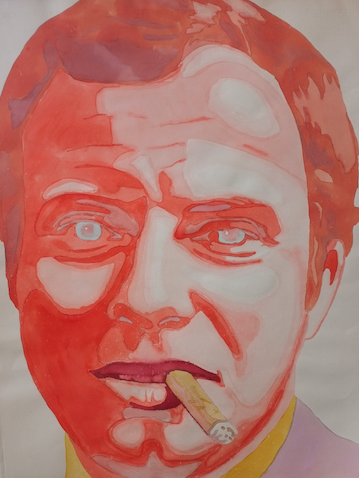
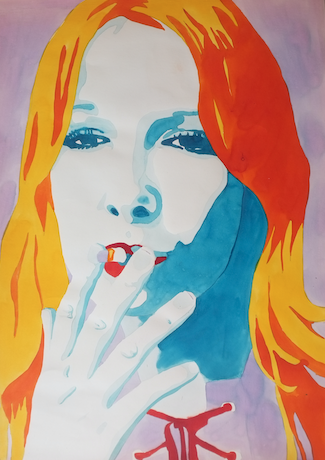
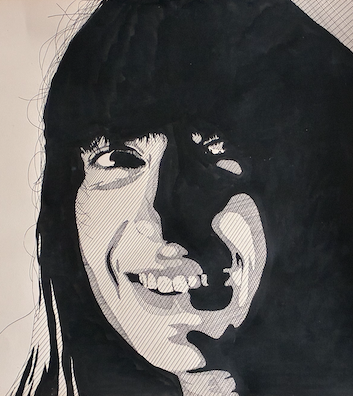
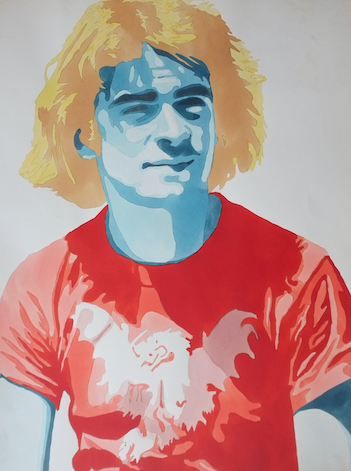
1971. For several years I continue to project slides in order to draw with colored inks on paper or to paint on canvas with acrylic colors.
I photograph creative colleagues at the advertising agency in order to make these portraits, for example.
|
| |

|
|
1972. I draw members of my family.
From top to bottom:
My mother, drawn in colored pencils on pieces of glued paper that have not withstood fifty-five years in a portfolio very well.
Cathie, India ink on paper. We have known each other for a long time. We married in January, 1969.
My brother Olivier, aged twenty-two, colored inks on paper. He is going through a flamboyant period that I try to express through my choice of colors.
|
| |
 |
|
1977. My eldest son, aged five. Acrylic painting on canvas, 50 x 100 cm. |
| |
1990. I write books about the Macintosh and its software since 1988. I write one in 1990 about a new drawing program, Illustrator. I study it closely and begin using it to draw on the computer screen.
I made all the drawings below on a Macintosh using Illustrator. I drew the first ones with the mouse, then I used a graphics tablet as soon as models more convenient than the mouse appeared. I digitized the photographs with a Nikon slide scanner.
|
| |

|
|
I made this drawing after 1990 with Illustrator, based on a photograph taken in 1966 from École Polytechnique.
As with the photograph of La Méthode, I was using a Nikkorex camera—a cheap Nikon sub-brand—that I bought in 1964. It took good photographs in bright light, but backlit shots were underexposed. This underexposed image looks pretty good, though.
I entrust the PDF files to a print shop, which makes 70 x 50 cm prints with a large inkjet printer.
Placed under glass and framed, they hang on the walls like so many illustrated memories.
|
| |

|
|
1967. When I hitchhike from Paris to Calcutta, I take nothing valuable with me—neither a watch nor a camera—so as not to tempt potential thieves.
On the SS Cambodge of the Messageries Maritimes line, which is taking me from Bangkok to Kobe toward the end of August, two young Americans share my cabin. One has a Nikon F, the other a Pentax Spotmatic, so I can compare the cameras.
The Pentax is smaller and lighter, much more pleasant to hold. I very much like the Fresnel-lens viewfinder system.
I hitchhike from Kobe to Tokyo. I go to the American Express office where a new credit card (mailed by my mother) is waiting for me. I can then buy a Pentax in a shop at the Imperial Hotel recommended by one of my cabinmates.
I want to visit Kyoto and Hiroshima. Instead of hitchhiking to Kyoto, I try a marvel of technology: the Shinkansen train, which travels at 300 km/h (since 1964, the year of the Tokyo Olympic Games).
This drawing reproduces the first photograph taken with my Pentax.
|
| |
|
|
September 1967. The American Express office is also a travel agency. I buy a Tokyo–Paris ticket via the Soviet Union: from Yokohama to Nakhodka, in eastern Siberia, by boat; from Nakhodka to Khabarovsk, on the Amur River, by night train; from Khabarovsk to Moscow by plane, with a two-day stopover in Irkutsk in memory of the Jules Verne hero Michel Strogoff; and from Moscow to Paris by train.
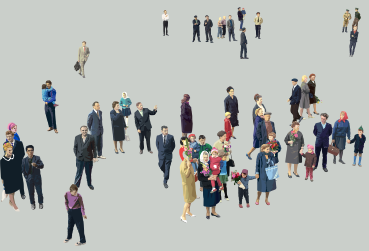
This image shows people who have come to welcome some of the ship’s passengers in Nakhodka. In the original photograph, taken from the boat, one can also see a refreshment stand and a building. I removed them, which is easy with Illustrator, to make the image a little mysterious: one wonders who these people are.
|
| |

|
|
I took the original photograph from an apartment on the French riviera around 1970. I projected it onto a canvas and painted an image with acrylic colors.
I digitized the photograph with the Nikon scanner, which I bought around 2005, and created this version of the image with Illustrator.
|
| |

|
|
I returned to the photograph of Fifth Avenue that was screen-printed in 1969, digitized it, and made this image. It is more “photorealistic” than the screen print, but the flat areas of the sidewalk show that it is a drawing. |
| |
|
|
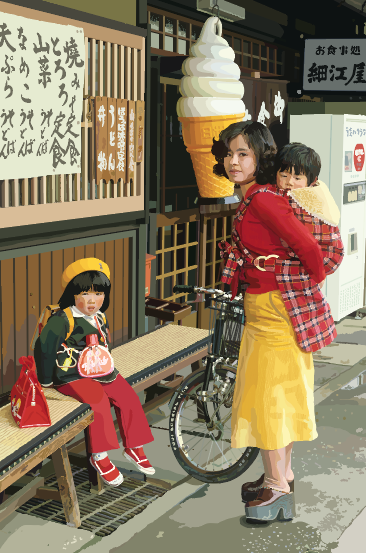
I returned to Japan several times from 1975 onward to do reporting for Marie-Claire, and later to accompany Cathie, who was taking care of affairs inherited from her mother.
The photograph on which this drawing is based dates from 2012. It is one of the first I took with the Fujifilm X100 digital camera that replaced my good old Pentax that year.
|
| |

|
|
I took the photograph I used for this drawing from an apartment on Lexington avenue, which we exchanged for our own in Paris.
It was
the New York pied-à-terre of a woman who lived in Houston. She ran a store there selling furniture and various objects.
|
| |

|
|
From time to time I would wander in my neighborhood to take photographs that might become drawings.
The shadows of the trees are not photorealistic, but the lady from Houston nevertheless liked this view of the Place des Vosges very much. The image hanging on my wall at home measures 50x70 cm (it is slightly cropped here, like all the others).
She asked me whether I could sell her a copy four times larger. I ordered a 100x140 cm print from the printer, which she bought from me for perhaps two hundred euros. She put it up for sale online for two thousand dollars. I don’t think she sold it, because she did not buy another one from me. |
| |

|
|
Based on a photograph of the Île Saint-Louis taken during another walk around my neighborhood. While drawing the water of the Seine, I thought of Vija Celmins’s waves, though I did not yet know her name. |
| |

I started from a photograph taken in China in 1984 during a reporting assignment for Marie-Claire. It took me months to draw the stones of the ballast, and eight months to complete the whole drawing.
|
| |
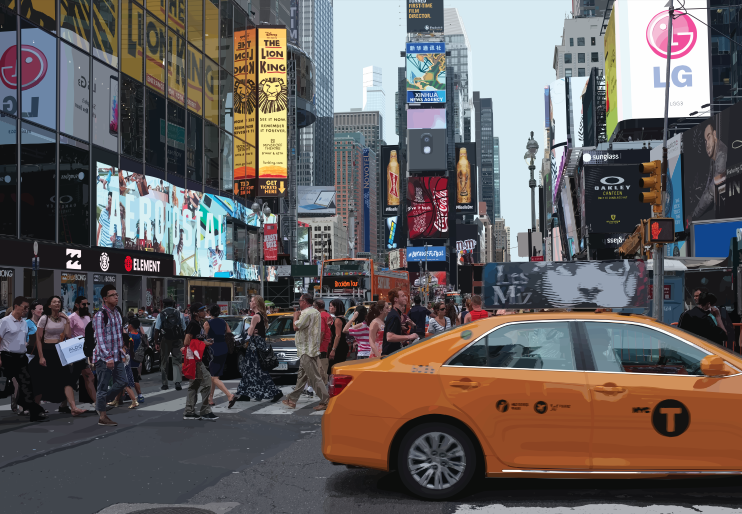
It took me nearly a year to make this drawing from a photograph of Times Square. The print hanging on my wall at home is twice as large as the previous ones: 70x100 cm. The same is true of the next two.
|
| |
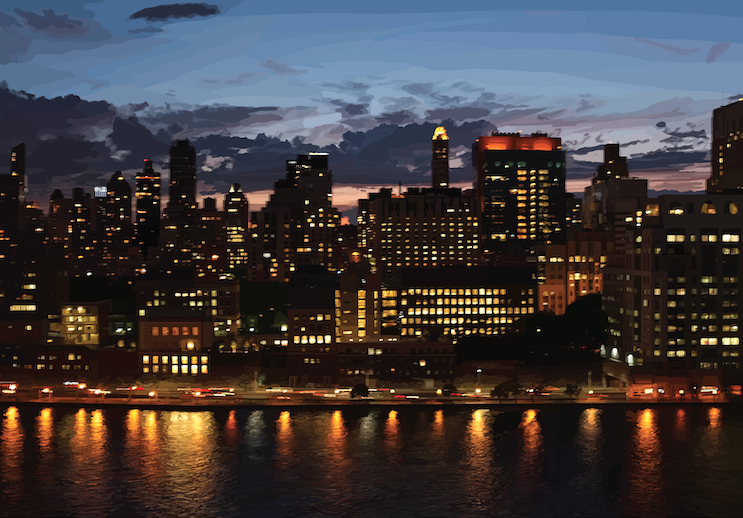
This drawing reproduces a photograph I took from an apartment on Roosevelt Island, in the middle of East River. We could not go to Manhattan by subway because of work on the line. Fortunately, we still had the cable car, which reminded us of winter sports in the Alps.
|
| |
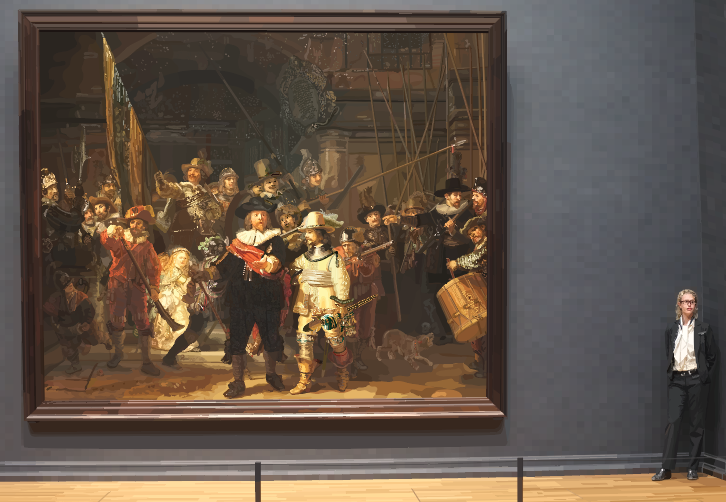
We went to Holland for a concert of my brother’s music.
I suppose there is usually a crowd in front of The Night Watch. I did not remove the crowd with the magic of Illustrator or ChatGPT; instead, we got up early and entered the Rijksmuseum at opening time. It took me more than a year to make this drawing.
|
| |
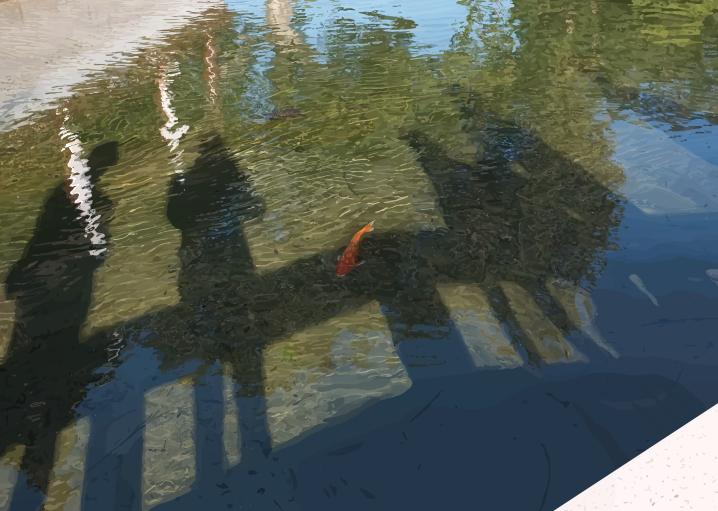
Another unconscious homage to Vija Celmins. Also an homage to Vivian Maier, who liked to take pictures of her shadow. Yes, I am right there, second from the left, photographing the Japanese pond at Pasadena’s Huntington Gardens. |
|
|