

Bloomsbury USA published The Fighter, my own translation of the best-seller among my twenty or so French novels, in 2006. If you want to read it, you can buy it online, as the digital version is still on sale.
I translated several of my other novels, but I didn’t convince Bloomsbury USA to publish them. You can still read them, though: just click a blue title below to display the novel on your screen or download its PDF file.

The narrator of this wild tale has a knack for languages. He learns the language of chimpanzees and adopts two young apes, Big Sister and Little Brother.
He does speak with a heavy foreign accent, so the chimps just don’t understand when he says: “Please tidy up your room… Stop throwing mashed potatoes at the ceiling…”
This was my first published novel. The publisher, l’École des Loisirs, stopped selling it after nineteen years and allowed me to give it away on my website.

I, Marilyn
This is the story of Marilyn Monroe as told by herself, from her early childhood to the day when she gobbled one pill too many.
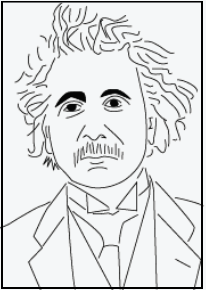
A student refuses to sit at the same table as Albert Einstein in the Princeton cafeteria. “You and your bomb!” she says. He protests: “It’s not my bomb,” but she is gone already. So he writes a letter to tell her about his life and work. He takes care to explain his theories and discoveries as clearly as possible.

She’s a strong-willed girl in Poland, a student in Paris, a member of the French Résistance during the second world war, a prisoner of the Gestapo… She falls in love with Lonek, known as “Jacques” in the Résistance. Three weeks after they decide to have a baby and name him Jean-Jacques, the Germans arrest Lonek and send him to Auschwitz.
He is a ladies’ man; a jealous mistress denounced him…
This novel is based on my mother’s story. It is the first book in a trilogy. The two other books are based on my father’s story and on mine. They are great favorites with my faithful readers and were featured on a full page in Libération, a leading French daily.
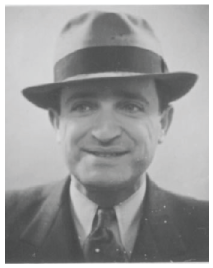
Lonek
Lonek is the son of an inn-keeper in a
remote Polish corner of the Austro-Hungarian empire. He admires the hussars
and lancers who come to the inn, drink his father’s famous beer and
dance with the beautiful “bar-girls.” Although he’ll become
a bright student, a virtuoso pianist and eventually a doctor in Paris,
he’ll always be fond of the kind of plain people you meet in an inn—and
he’ll never be able to resist the lure of a beautiful woman.
During the war, he enrolls in a communist Résistance network. While
the police sets a trap in his apartment and catches his group, he is lucky
and escapes… until a jealous mistress denounces him.
In Auschwitz, he survives the first terrible weeks because he is strong
and resourceful, then he finds a job as a doctor in the camp’s hospital.
He hides in the camp when the Germans evacuate it. He is the first person
to come out of the camp alive, three days before the arrival of the Russian
army.

No Accent
The narrator is the son of Lonek and Malvina. A clone of myself, in a way.
As soon as I understand the words bathroom and gas, I learn that my father survived in a camp where mothers and children were sent to gas chambers disguised as bathrooms. As a consequence, I become quite distrustful. I don't tell my pals that I am Jewish. Next time the nazis come, I’ll flee to America.
A peculiar feature of this story is that Lonek and Malvina, who were glorious heroes in their own books, become horrible tyrants in this one.

Hitchhiking
In No accent, I concentrate my mind wonderfully on math and physics in the tough classes préparatoires system. In this book, I take well-deserved vacations. I follow Christopher Colombus and Alexander the Great. I visit—or at least pass through— Cheyenne and Laramie, Trabzon and Tabriz, Lahore and Indore.
All over the world, when I reveal I’m French, people say: “France? De Gaulle!
Brigitte Bardot!”

In 1939, when German bombs begin to fall on Warsaw, Kama is ten years old. She decides to write a diary. She tells how she flees with her parents to Byelorussia, then Ukraine, Azerbaidjan, Georgia, Armenia, Turkmenistan. They settle eventually in a village in Uzbekistan, in Central Asia. She learns more than if she were going to school, and so do we.
This novel is based on a true story.

I don’t have a picture of the summer camp during the war, so here’s a photograph that Madame Christiane
gave me when I interviewed her.
She may have taken it in 1952.
The two small boys are my brother Michel and I. He is the blond one.
Children, we’re at war
1939. The children are spending their vacations in the Pylon summer camp in Mimizan-Plage, on the Atlantic Ocean south of Bordeaux. They play marbles and gather blackberries. On the first day of September, the war begins.
I went to the Pylon summer camp many times myself in the fifties. I knew the founder and director of the camp, Madame Christiane, quite well. I happened to see her again in 1988. She was 82 years old and her daughter-in-law ran the summer camp. Madame Christiane told me she had become a student. She studied art history, prehistory, and social anthropology. “I am the oldest student in France,” she said.
I was a journalist
at Marie-Claire magazine then. I interviewed people who had unusual things to tell. I interviewed her, as The oldest student in France. Halfway through the interview, she said: “All this is not as interesting as what I did during the war.”
She told me that people in Paris were sending their children to the countryside in September, 1939, as they were afraid the Germans would bomb Paris as they had bombed Warsaw. She asked the parents of the campers whether they prefered their children to come back at the end of September as usual, or to stay in the camp. Some children left the camp, some stayed until the end of the war. In June, 1940, the Germans vanquished and invaded France. A few months later, laws were edicted against the Jews. There were some Jewish children in the camp. Madame Christiane changed their names.
The interview was published in the April, 1988 issue of Marie Claire.
In 1994, I met an editor in charge of publishing stories in a monthly magazine for teenagers. She said she was always looking for new stories. I thought of Madame Christiane’s war adventures. I imagined that I was a young Jewish boy named Jacob, who becomes Jacquot and stays four and a half years in the camp. The magazine published the story in 1996, under the title “De trop longues vacances (Too long vacations).” It was my first published fiction. I was 51 years old already.
A few months later, L'école des loisirs, a leading publisher of books for children, teenagers and young adults, published my first book, Honey paradise. After they had published a few, I thought it would be nice to have De trop longues vacances among them.
It was too short to become a book, though. Madame Christiane has died in 1997, aged 91. I interviewed her eldest son, some former campers who has spent the war in the camp, and one of the two counsellors assisting Madame Christiane. L'école des loisirs published the novel Mes enfants, c’est la guerre in 2002.

The soul-mending thread
Why do people suddenly call Kenichiro a “Jap”? Why is he deported to a camp in the middle of Arizona? He is American, isn’t he? Born in Los Angeles, a student at Thomas Jefferson school.
Yuriko is definitely Japanese, born in Hiroshima.
This novel tells the unlikely meeting of
Yuriko and Kenichiro in 1944, during the war between their two countries.

Nine eleven
I interviewed a group of students at Stuyvesant High School, some months
after the nearby Twin Towers were attacked and they were evacuated. I wrote a book in English based on what they told me and
translated it into French. The French version was published in 2003. My American publisher was interested, but then
chose to publish The Fighter instead. I kept the rights for the English
language, so I can put the full text on my website.
The French book became quite a success. While it was published in a young-adult series, a
Spanish translation was published as a book for the general public.

Christopher Colombus returns
The crews are grumbling. Where are they, the golden pagodas of Cipango? The voyage has already lasted far longer than expected. All one can see is the ocean—always the ocean. Christopher Columbus himself is beginning to lose heart. He doubts. He feels old and fragile.
Yielding to the sailors’ pleas, he decides to turn back. He becomes a carpenter near Cádiz.
Will he know new adventures?

Albert & Marilyn
I had the opportunity to read a series of previously unpublished conversations between Albert Einstein and Marilyn Monroe. A mutual friend, the photographer Philip Halsman, introduced them to one another. He was the one who photographed Einstein for the 8-cent postage stamp, and Marilyn for the 32c stamp.
Halsman would never have photographed them if Einstein had not saved his life—twice, in fact—as I recount in this book.
Note for scholars: this work is both a double biography in the manner of Plutarch and a dialogue in the manner of Plato.
All the novels above have been published in French. I signed a contract and received some money for the first novel below, but the publisher wasn’t happy with the editor for some reason and let her go. Several contracts were canceled, including mine. I do hope I’ll find another publisher eventually, as I think it is an important book.
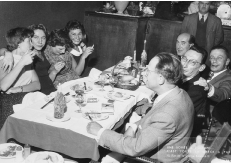
My parents (closest) and some of their friends.
It so happens that my parents had unusual and interesting lives, so I wrote novels about them. Then I thought that their friends also had interesting lives. I spent a few years interviewing them at length, then I wrote this novel. War and Peace would have been a good title for this book, but someone had already used it.

As I didn’t find a picture of Albeniz playing piano as a child, I put a picture of my brother Olivier, who was also called a new Mozart.
Albeniz
A friend of mine made a movie that was a complete failure in France.
But then Miramax bought the rights.
“Miramax belongs to Walt Disney,” my friend told me. “I need to think
of a new film. This is quite an opportunity, you know.”
“I have got a good story for Walt Disney. Isaac Albeniz.”
“Who?”
“Albeniz. He was a famous Spanish pianist and composer. My story
is about his childhood. He was known as El nuevo Mozart. He escaped from home to go on tour by himself
when he was ten years old, then again when he was twelve.”
I told him more about Albeniz. He asked me to write a script. By the time
my script was ready, his movie had failed as miserably
in America as in France.
“It came out the same week as The Titanic,” he said.

The cat in the maze
This tale is somewhat similar to the Albeniz
story, except the main character is a cat instead of a music composer.
While Albeniz only goes to South America, this little cat travels around the world and has all kinds of strange adventures.

The fence
This short story is translated and adapted from a radio drama I wrote some years ago for the France-Culture public channel. It is based on the true story of a Jewish girl who survived World War II by being hidden. As the mother has to sing a Yiddish lullaby, she was played by Talila, a well-known French singer of Yiddish songs.

This is a book
Many people, in France and other countries, have studied English for years in school but cant’t read a short newspaper article or technical manual in English. This suspenseful and entertaining story progresses from simple words and short sentences to not so simple words and somewhat longer sentences, taking the reader along, so that eventually he or she can read my other books—then Agatha Christie, P. G. Wodehouse and Dickens.
The novels below have been published in French but I didn't translate them. They are not on sale anymore, so you can read them—in French—on my website.

Les larmes du samourai (The crying Samurai, École des
Loisirs, 1997).
Yoshitsune is Japan’s favorite hero. He lived for real in the twelfth
century, but he is better known as a character in books, theater plays
and TV series, a kind of young superhero with magical powers who turns
into a pathetic failure fleeing the wrath of his half-brother.
Since the Japanese know Lancelot and John of Arc, I think the French and
American people should read about Yoshitsune,
so my next project is to translate it into English with the help of my sorcerer’s apprentice ChatGPT.

The life of Beethoven. He is filthy, uncouth and short-tempered. He admires Bonaparte, hates Napoleon. He insults his friends and patrons. He composes works of genius that nobody understands. He falls in love with the beautiful Vienna aristocrats he teaches piano to. Alas, beautiful aristocrats can’t love him. A princess can marry a filthy, uncouth and short-tempered man, but only if he is a prince. So Beethoven is very unhappy.
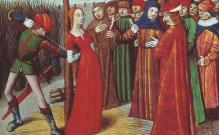
The real life of Jeannette, whose name never was Jeanne d’Arc. With battles, a coronation and two strange saints. A story that doesn’t end well, but there’s nothing I can do about it.
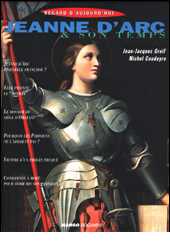
Jeanne d’Arc et son temps (Joan of Arc and her times, Mango,
1999).
I like Jeannette so much that I also made this illustrated book with art
director Michel Coudeyre.
You’ve certainly heard about Joan of Arc, but did you know she was
condemned to death and burned for wearing pants?

Composed when he was five years old
Les souffrances du jeune Mozart (The suffering of young Mozart, École des Loisirs, 2001).
I wrote one half of this book. Who wrote the second half? Mozart himself!
Having neither asked for his authorization nor shared my royalties with
him, I quoted many letters he wrote to his parents, his sister and his cousin.
They reveal a strange character, obsessed by various body fluids and natural
functions. A proud genius, in love with freedom, who chooses to be poor
rather than obey a stupid prince. A tender lover, who put more love into
music than anybody ever did.
This book has been translated into German and published by Bertelsmann.

La cigale et la télé (The cicada and the TV)
Jean de la Fontaine wrote famous French fables inspired by Aesopus. Half of the fables in this book are his, half are mine.
I don’t know whether mine will become as famous as his, but they are more up-to-date.
They have cars, TVs, computers, and all the wonders that make today’s world so fabulous.

Galilée (Galileo)
The enamel signs on a street near the Champs-Élysées say “Galileo, astronomer.” He discovered some things in the sky by chance, but he was not an astronomer. He did not say, “And yet it moves.” Nor did he prove that the Earth does move. The Church cannot rehabilitate him, because he did indeed commit the offense for which he was condemned.
He loved his daughter dearly. He wrote a magnificent book. He invented modern science.
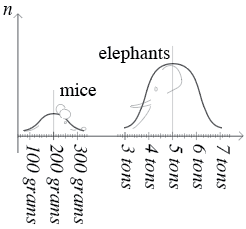
J’ai mal aux maths, mais je me soigne (Math makes me sick, but I know a good medicine)
This book pretends to demonstrate the following theorem: “Mathematics have been invented by fools like you and me, thus any fool can understand them.”
I made the book’s illustrations myself. Yep: drawing has been invented by fools like you and me, so any fool can draw.